
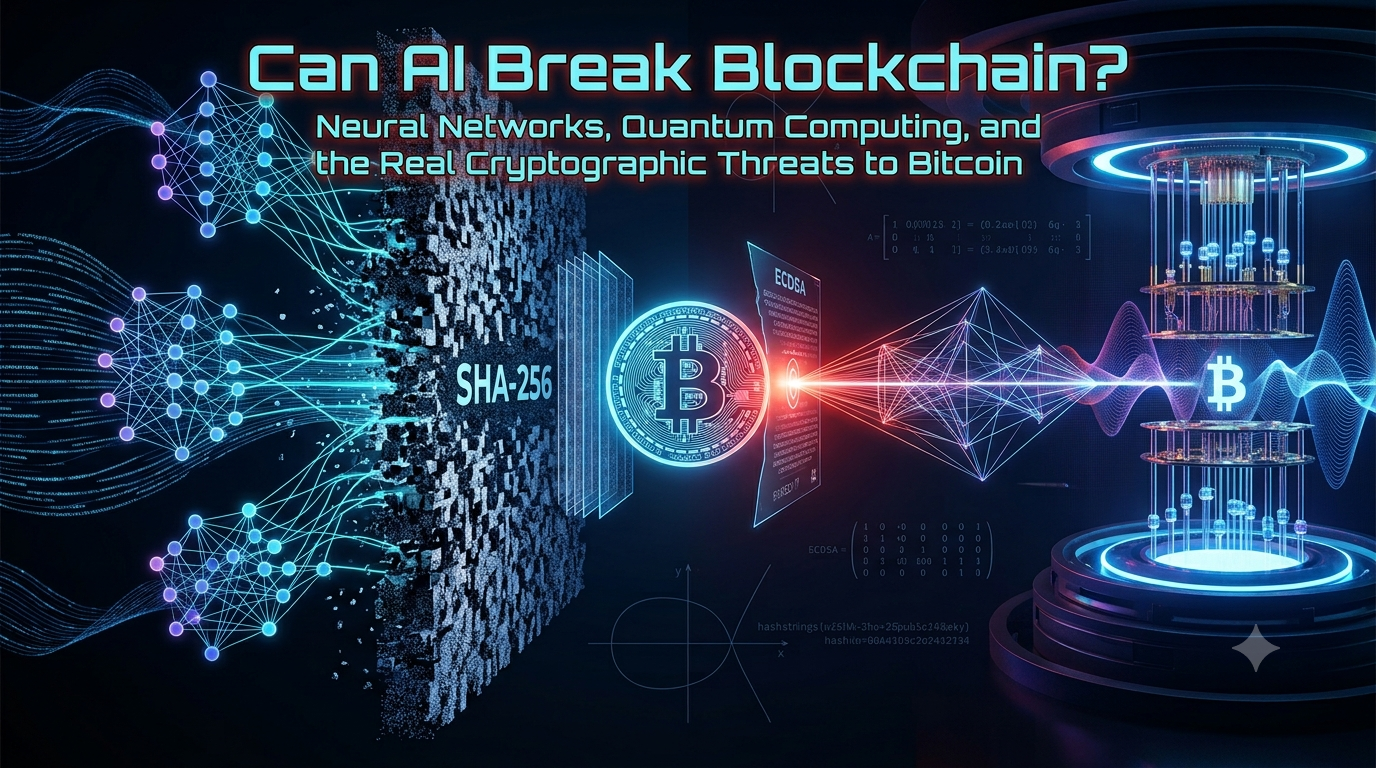
Can AI Break Blockchain? Neural Networks, Quantum Computing, and the Real Cryptographic Threats to Bitcoin
I get asked about this a lot. With artificial intelligence expanding at a terrifying pace and quantum computing milestones hitting the news every few months, people are starting to worry about their cold storage. The fear is simple: if our entire financial alternative is built on math, and machines are getting incredibly good at math, is Bitcoin safe? To answer the question, can AI break blockchain security, we have to look past the sensational headlines and dig into the actual computer science.
When you separate the marketing hype from the hard cryptanalysis, the threat landscape looks very different. Neural networks are fundamentally incapable of cracking secure cryptographic hashes, meaning that if we ask whether can AI break blockchain hashing, the answer is a resounding no. However, quantum computing does present a real, well-defined threat to digital signatures. Fortunately, the roadmap to defend the blockchain is already being built.
Neural Net Accuracy
0.0%
On reversing SHA-256 hashes
Grover’s Attack
128-bit
Remaining security for SHA-256
Shor’s Attack
Critical
Threat to exposed ECDSA keys
PQC Migration
Active
BIP 360 and BIP 361 proposals
Can AI break blockchain hashing? Why neural networks fail
Let’s start with the core question: can AI break blockchain cryptography? The theory goes that since neural networks are universal function approximators, you should be able to train a massive model to reverse a hash function. You feed it billions of SHA-256 hashes and their inputs, let it backpropagate, and wait for it to start spitting out private keys. It sounds plausible if you treat AI as magic. In reality, it fails immediately because of how neural networks actually work. Just as we use rigorous, data-driven backtesting to separate market myths from reality, like we did in our S&P 500 index addition strategy analysis or our S&P 500 dividend stocks study, we have to look at the raw data when evaluating AI’s capabilities.
Neural networks learn by following gradients. They need a smooth, continuous mathematical landscape. If you make a tiny change to the input, you need a tiny, predictable change in the output. When the model makes a mistake, the loss function shows it which way to nudge the weights to get closer to the target. That is how they learn to recognize faces or write text.
Cryptographic hashes are built to do the exact opposite. They rely on the avalanche effect. Flip a single bit in a 256-bit input, and the entire SHA-256 hash changes completely. Half the output bits flip at random, and the new hash has zero correlation with the old one. There is no smooth valley for the network to navigate. It is just a chaotic, jagged cliff face. No gradients to follow, no patterns to recognize, and nothing for backpropagation to grab onto.
Could an AI find a zero-day vulnerability in the SHA-256 algorithm itself? Sure, maybe an AI-driven fuzzer or a specialized math model finds a shortcut that human cryptographers missed over the last twenty-five years. But SHA-256 has been poked and prodded by the best minds in the world since 2001. If a structural flaw is ever found, it will be a major mathematical breakthrough, not something a neural network stumbles on by brute-forcing training data. So if you are asking can AI break blockchain protocols by cracking the hash function itself, the historical resilience of SHA-256 suggests it is highly unlikely.
The real quantum threat: If not AI, can quantum computers break blockchain?
While we have established that we do not need to worry about whether can AI break blockchain hashing, quantum computing is a different story. We need to separate the sensationalized “Q-Day” headlines from the actual mechanics. Bitcoin’s security relies on two entirely different cryptographic building blocks, and they react to quantum attacks in completely different ways.
The first is the Elliptic Curve Digital Signature Algorithm (ECDSA), specifically the secp256k1 curve. This is what Bitcoin uses to generate public keys from private keys and to sign transactions. The security of ECDSA rests on the elliptic curve discrete logarithm problem. On a classical computer, working backward to find a private key from a public key is practically impossible. It would take billions of years.
In 1994, Peter Shor published an algorithm designed specifically for quantum machines. Shor’s algorithm solves the discrete logarithm problem in polynomial time. That means a sufficiently large, fault-tolerant quantum computer could reverse the process and derive a private key from an exposed public key in minutes.
This is a real threat, but we have to look at how Bitcoin addresses actually work to understand the real-world risk. Bitcoin has a few different address formats, and they do not all expose public keys the same way:
- Legacy Pay-to-Public-Key (P2PK): This was used in the earliest days of Bitcoin, including the blocks mined by Satoshi Nakamoto. These addresses store the raw, unhashed public key directly on the blockchain. A quantum computer running Shor’s algorithm could target these addresses immediately, which puts roughly 1.1 to 1.7 million BTC at risk.
- Modern Hashed Addresses (P2PKH, SegWit, Taproot): These formats do not put the raw public key on the blockchain. Instead, they store a double hash of the public key (using SHA-256 and RIPEMD-160). The public key is only revealed to the network when you actually spend funds from that address.
For modern hashed addresses, a quantum attacker cannot touch your funds while they are sitting cold in your wallet. The public key is simply not visible. The vulnerability window only opens when you broadcast a transaction to the mempool. A quantum attacker would have to intercept your transaction, run Shor’s algorithm to derive your private key, forge a new transaction with a much higher fee, and broadcast it to front-run your original transaction before the next block is mined. That is a highly complex, time-sensitive attack that requires immense real-time quantum processing power.
Grover’s algorithm: Can quantum AI break blockchain mining?
The second building block is the SHA-256 hashing function, which secures Bitcoin’s proof-of-work mining and protects addresses. Many people assume that if quantum computers can break elliptic curves, they can easily break hashing. This is a common misunderstanding that conflates two very different quantum algorithms. In quantitative finance, we often talk about the importance of having a clear, rules-based plan rather than holding onto losing positions in the hope of a miracle, a psychological trap we explored in our guide on why the hold until break even mindset destroys returns. Hashing functions present a similar mathematical reality: you cannot simply wait and hope for a classical or quantum shortcut to solve an exponentially hard problem.
Quantum computers attack symmetric hashing functions using Grover’s algorithm, published in 1996. Unlike Shor’s algorithm, which provides an exponential speedup by exploiting the specific mathematical structure of elliptic curves, Grover’s algorithm only provides a quadratic speedup for unstructured database searches. It is essentially a faster way to brute-force a solution.
In practice, Grover’s algorithm halves the effective bit-security of a hash function. For SHA-256, this means a quantum computer can find a collision or preimage in roughly 2128 operations, rather than 2256. While halving the security sounds alarming, we have to look at the scale of the remaining security:
The scale of 128-bit security
A 128-bit keyspace contains roughly 3.4 × 1038 possible combinations. To put this in perspective, if you turned every classical computer on Earth into a quantum machine and let them run for the entire age of the universe, they would not crack a single 128-bit key. The physical energy required to perform 2128 operations exceeds the total thermodynamic energy of the observable universe. SHA-256 is, for all practical purposes, completely quantum-safe.
The self-correcting mining network
What about quantum mining? If a miner builds a quantum computer running Grover’s algorithm, they would have a quadratic advantage over classical ASIC miners. However, Bitcoin’s automatic difficulty adjustment would quickly compensate. As the network’s hashing power rises, the difficulty adjusts upward, keeping block times at ten minutes. Quantum mining would simply become another hardware race, much like the transition from CPUs to GPUs and then to ASICs. It cannot break the fixed 21 million supply cap or bypass block validation rules.
The post-quantum roadmap: Preventing AI and quantum tech from breaking blockchain
The threat of a quantum computer powerful enough to break elliptic curves is real, but it is not going to surprise us overnight. When we discuss how can AI break blockchain networks, we must realize that the real-world focus is on quantum-resistant upgrades rather than machine learning threats. Cryptographers and standards bodies have been preparing for this for over a decade. In August 2024, the National Institute of Standards and Technology (NIST) finalized its first three post-quantum cryptography (PQC) standards, including ML-DSA (a lattice-based digital signature scheme) and SLH-DSA (a stateless hash-based signature scheme).
The Bitcoin developer community is already working on integration pathways. Because Bitcoin is a software protocol governed by consensus, migrating to quantum-resistant signatures requires a soft fork. This is a backward-compatible upgrade that the network has successfully executed multiple times in the past, most recently with the Taproot upgrade in 2021.
The transition plan is being outlined in proposals like BIP 360 and BIP 361:
- BIP 360 (Pay-to-Merkle-Root): This introduces a new transaction output type that hides public keys behind a quantum-safe Merkle tree structure, ensuring that public keys are never exposed on-chain until the moment of spending.
- BIP 361 (Post-Quantum Signature Transition): This outlines a multi-phase roadmap to sunset legacy ECDSA and Schnorr signatures over a multi-year period, giving users ample time to move their funds to new, quantum-resistant addresses.
The primary challenge of migrating to post-quantum cryptography is not the math; it is the data footprint. Quantum-resistant signatures (like those based on lattices) are significantly larger than ECDSA signatures, often by a factor of ten or more. This means that a post-quantum Bitcoin transaction would take up much more block space, leading to higher transaction fees and increased storage requirements for node operators. Developers are actively researching optimization techniques to minimize this overhead before the migration becomes urgent.
What about the “harvest now, decrypt later” (HNDL) strategy? This is a major concern for encrypted communications, where adversaries collect encrypted data today with the intention of decrypting it once quantum hardware matures. For public blockchains, however, this is less of an issue. A blockchain is already public and immutable. There is no encrypted data to harvest and decrypt later. The only risk is if users leave their funds in legacy, public-key-exposed addresses (like Satoshi’s coins) indefinitely. Those specific funds may eventually be lost or frozen by network consensus to protect the system’s integrity.
The honest verdict: Can AI break blockchain in the future?
When you look at the technical details, the conclusion is reassuring. If you came here asking can AI break blockchain, the answer is a clear and definitive no. Your Bitcoin is safe from AI, neural networks, and machine learning models. The fundamental laws of thermodynamics and information theory protect cryptographic hashes from being reversed by pattern-recognition algorithms. AI is an incredibly powerful tool for writing code, optimizing trading strategies, and finding bugs in complex smart contracts, but it cannot bend the laws of mathematics. If you want to see how we use systematic, code-based execution to find a real edge in the markets, check out our automated intraday volatility breakout strategy or our 26-year backtest of the Nasdaq 100 momentum strategy. For European investors looking for structured, long-term equity exposure, we also analyzed the GARP ETF as a high-quality alternative to standard indexing.
Quantum computing is a genuine, slow-moving challenge that the entire global financial system must address over the next decade. Bitcoin is in a unique position here. Unlike legacy banking systems, which are bogged down by decades of bureaucratic inertia and proprietary software, Bitcoin is an open-source, highly adaptable protocol. The cryptographic tools to secure the network against quantum attacks already exist, and the migration path is being laid out. As long as the community maintains its technical coordination, the transition to a post-quantum blockchain will be completed long before a cryptographically relevant quantum computer is built.