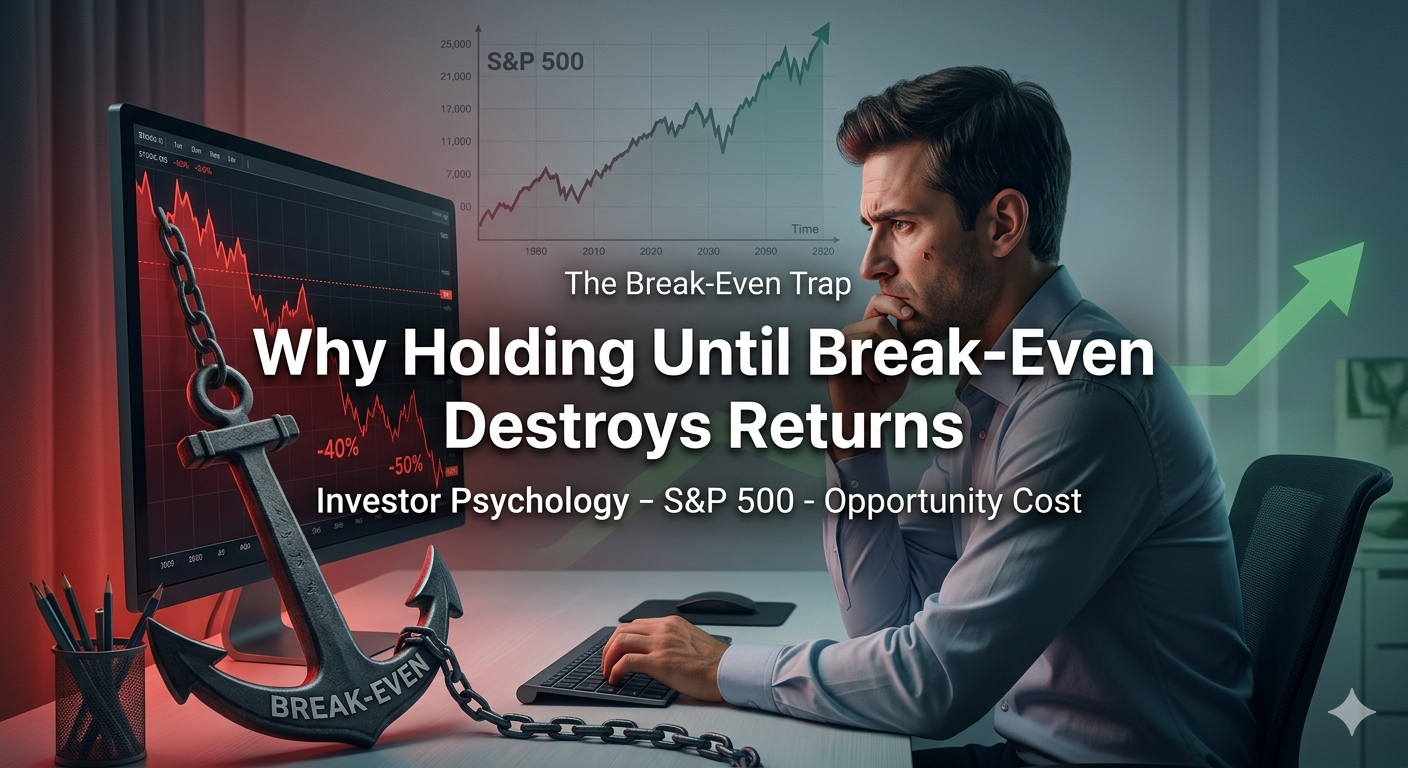
You have probably said it — or heard it at the kitchen table: “I’m not selling. I’m down. I’ll wait until I’m back to even.” It feels responsible, even patient. Like you’re refusing to panic. The problem is that the market never agreed to your personal break-even price. And while you wait, your money sits in the wrong place, earning nothing useful, while the voice in your head keeps whispering that selling would mean admitting defeat.
Below is why that instinct is so strong, what it has cost real people in real crashes, and what actually helps: not willpower in the red, but a plan you wrote before things went wrong.
Why Your Brain Fights You on This
In normal life, quitting feels like failure. You bought the ticket — you go to the show. You started the degree — you finish. That habit travels with us to the brokerage app. Economists call it the sunk cost fallacy: past money already spent is gone, but we treat it like a reason to keep going.
Then there is loss aversion. In the late 1970s, Daniel Kahneman and Amos Tversky mapped out prospect theory — the idea that people do not weigh gains and losses symmetrically. A loss hurts more than an equal gain feels good. Later work often summarized the ratio at about 2:1. Clicking “sell” on a red position is not a spreadsheet move. It is voluntarily taking a hit your nervous system would rather postpone.
Finance researchers Hersh Shefrin and Meir Statman put a name on what most of us do anyway. In a 1985 paper they documented the disposition effect: we sell winners too early and ride losers too long. Not because the data says so — because selling a loser feels like closing a bad chapter in ink you cannot erase.
Disposition effect
Retail investors systematically dump stocks that went up and cling to stocks that went down — even when the loser’s outlook is worse.
Mental accounting
Each ticker becomes its own story: “It has to get back to $120.” The rest of the portfolio fades into the background.
Break-even bias
After a fall, we anchor on what we paid and treat that price like a magnet — even when the business behind the stock has changed.
The Math Nobody Wants to Do
Here is the part that does not fit on a bumper sticker. Lose 50% and you do not need “half back.” You need a 100% gain just to stand still. The deeper the hole, the steeper the climb — and most people never bother to count how many years that climb takes while the S&P 500 quietly compounds elsewhere.
How much must you earn to get back to your purchase price?
After a −20% loss
After a −40% loss
After a −50% loss
After a −80% loss
Required percentage gain to recover from a loss
Horizontal axis: loss from purchase price. Vertical axis: gain needed to reach break-even. The steeper the curve, the nastier the trap.
| Loss from purchase | Gain to break even | Years at +8%/yr | Years at +4%/yr | “Never” risk |
|---|---|---|---|---|
| −10% | +11.1% | ~1.3 years | ~2.7 years | Low (solid company) |
| −30% | +42.9% | ~4.6 years | ~9.1 years | Moderate |
| −50% | +100% | ~9.0 years | ~17.7 years | High (weak company) |
| −70% | +233% | ~16.4 years | ~32+ years | Very high |
| −90% | +900% | ~31+ years | ~60+ years | Near-permanent loss |
At a long-run index pace of roughly 7–10% a year, digging out of a 50% hole is often a decade-long project — not a bad quarter you can sleep off. And that assumes the company you own is still the same story. Often it is not.
When “I’ll Wait for Break-Even” Actually Ruins People: Enron, 2000–2001
This is not a thought experiment. In the summer of 2000, Enron traded above $90 a share. It was a blue-chip darling — an S&P 500 name, celebrated in the press, held in pension plans and 401(k)s. Thousands of employees received company stock and matching contributions. Many kept buying, or simply never sold, because selling below what they “knew” it was worth felt like giving up.
By October 2001 the fraud was unraveling. The stock collapsed toward zero. Employees who had waited to “get back to even” on earlier dips did not get a recovery — they got wiped out. Congressional testimony later described workers who lost nearly their entire retirement savings because Enron stock had become most of what they owned, and because they held through a broken thesis while telling themselves the price would come back.
Enron was delisted in November 2001. It never broke even for the people who needed it to.
Enron (ENRN) — what “hold until zero” looked like in practice
Aug 2000 — peak area
Early 2001 — many still “waiting”
By late 2001 — bankruptcy
Loss if you held for “recovery”
The same pattern shows up elsewhere: Lehman Brothers (2008), Nortel, Kodak for buy-and-holders from the wrong era, former S&P 500 names that simply never returned to old highs. The index moved on. The people anchored to their cost basis did not always move with it.
The Quiet Cost: What Else That Money Could Have Done
The scarier number is often not on the losing ticker — it is the one you never see. Capital stuck in a dead position is capital not working in an index fund, a better idea, or even cash waiting for one.
Imagine two people. Both put $100,000 into a stock that drops 40% — they are sitting on $60,000. One holds five years hoping for “even”; the stock limps along at +5% a year and ends around $76,600 — still underwater. The other sells, swallows the loss, reinvests in a broad market fund, and earns 10% a year on average. Five years later that is about $96,600. Same starting mistake. Very different ending — because one of them stopped negotiating with the past.
Illustrative scenario: hold vs redeploy capital (starting after −40%)
Red: “hold until zero” — +5%/yr bounce from the trough. Green: sell, reinvest at +10%/yr. Excludes taxes and commissions.
After 5 years (nominal values, scenario above)
Hold — still −23% vs purchase
Reinvest — near full break-even
Gap in favor of B
Dead money in a zombie position
The S&P 500 Does Not Wait for Your Number
People talk about “the market” like it is one thing they are fighting. But the S&P 500 is a living list. Weak names get dropped. Stronger ones replace them. That is part of why the index has healed from so many crises over the decades — not because every single company came back, but because the basket changes.
When you hold one fallen stock until your personal break-even, you are not riding that renewal mechanism. You are betting on a single business the committee already decided did not belong. That can work — sometimes. It can also look like Enron: a former index member that never paid back the people who waited.
Index turnover
Many names rotate every few years. Institutional capital follows index weights. A stock outside the S&P 500 often loses liquidity and analyst coverage — making a return to old highs harder.
Extreme cases
Bankruptcy, delisting, −95% drawdowns with no decade-long recovery are not rare outliers in individual tickers — they remind you that a stock is a claim on one business, not a promise to revisit your purchase price.
Typical psychological vs economic paths
Investors mentally “cancel” the loss until they sell; meanwhile market value and opportunity cost keep moving.
“If I Don’t Sell, I Haven’t Lost” — Except You Have
Brokerage apps label it “unrealized,” which makes it sound provisional — like the loss is still up for debate. It is not. If someone bought your portfolio today, they would pay market price, not the price you remember fondly from 2019.
That little accounting trick nudges people toward strange behavior:
- Rejecting stop losses — because “I would realize the loss,” even as downside risk grows.
- Skipping rebalancing — losers shrink as a weight but still consume emotional bandwidth out of proportion to size.
- Averaging down without a new investment thesis — to pull average cost closer to the current quote so break-even feels nearer.
- Ignoring dividends and total return — only price vs purchase price counts, not full owner return.
Funds and ETFs cut and rotate all the time. Plenty of retail portfolios look like a trophy case of mistakes nobody wanted to admit. That is ego tax — not market tax.
When Holding Is Fine — and When It Is Just a Story You Tell Yourself
This is not a sermon about selling everything red. Sometimes you hold through a dip and you are right. The red flag is when the only reason is “I’m underwater and I refuse to lock it in.”
Rational hold
Thesis still intact; decline driven by market panic or sector cycle; horizon and risk fit the plan; position stays within allocation limits.
Broad index / ETF
A temporary S&P 500 drawdown has historically been recovered (not guaranteed short-term). Here “holding” reflects belief in the market as a whole — not loyalty to purchase price.
Behavioral excuse
“I’ll wait for zero” with no fundamental review, no exit plan, and capital frozen for years — that is decision avoidance, not strategy.
Tax-Loss Harvesting: Another Reason Not to Cling to Losers
In a taxable brokerage account, selling at a loss is not always “giving up” — sometimes it is plain good housekeeping. Tax-loss harvesting means realizing a loss on one position to offset capital gains you already booked (or expect to book) on others. You cut a weak name, bank the loss for tax purposes, and redeploy the cash — often into a similar but not identical holding so you stay invested.
Example: you sold Stock A earlier this year for a $20,000 gain. Stock B is down $8,000 and you were going to cut it anyway. Realizing that loss can reduce the taxable gain on A — in simple terms, you might owe tax on $12,000 of net gain instead of $20,000. The exact math depends on your tax bracket, holding periods (short- vs long-term), and other income — but the direction is clear: a realized loss can pay for itself in tax savings when you have gains elsewhere.
People sometimes hear “tax harvesting” and think it means keeping junk you should have sold months ago. It does not. You still need a real reason to exit — broken thesis, rule triggered, better use for the money. The tax angle just means that when you do sell red, you are not always throwing money away; you may be buying yourself a lower bill on the green trades you took elsewhere. Losses you do not use this year can often roll forward (details depend on your country and situation).
One U.S. gotcha: the wash-sale rule. If you sell at a loss and buy the same stock again within 30 days (before or after), the IRS may disallow the loss. Investors who want to stay exposed usually swap into something similar — an ETF in the same sector, not the identical ticker — or wait out the window.
Harvesting does not replace an exit strategy. It is a footnote that sometimes makes the right sell easier to swallow — especially when “I’m down” is the only thing stopping you, and you forget you also made money on something else this year.
Write Your Exit Rules Before You Need Them
Willpower fails in the red. Everyone’s does. What works is boring: decide in advance when a position is wrong — by percentage, by dollars, or by time — and treat a trigger like a fire alarm, not a suggestion.
You will take losses on some trades. That is normal. Even great investors are wrong often. The goal is not a spotless win rate. The goal is to keep one bad idea from eating five good years.
Good rules sound like this: “Down 20% from entry — I’m out.” “More than $5,000 lost on one name — I’m out.” “Eighteen months and the thesis has not moved — review and probably out.” Bad rules sound like: “I’ll sell when it feels bad.” Feelings are exactly what got you here.
Percentage stop
Loss cap as % from entry or from peak (trailing stop). Example: max −15% on a growth name, max −25% on a longer-horizon value holding. Simple and comparable across positions.
Nominal limit
Maximum dollar loss per position or per portfolio in a given year. Example: “no more than $3,000 lost on one ticker” — protects against “it’s only −8%” on a large allocation.
Time limit
Deadline to validate the thesis. Example: “review every 6 months; exit after 18 months with no progress vs benchmark.” Stops years of dead money.
Sample exit rules (illustrative — adapt to your risk and horizon)
| Rule type | Example | Protects against | Weaker when |
|---|---|---|---|
| Percentage | −20% stop from entry | Deep drawdowns, endless averaging down | High sector volatility — false breakouts |
| Nominal | Max $5,000 loss / position | Large allocations where % looks “small” | Very small accounts — dollar cap too rigid |
| Time-based | Review every 6 mo.; exit after 18 mo. flat | Years stuck in sideways drift | Cyclical names needing longer cycles |
| Thesis / fundamentals | Revenue down 2 quarters straight, share loss | Holding “to zero” on a broken business | Requires analysis — not for every investor |
Three exit rules to write down before you buy
Pick at least two. When one fires, you act — you do not renegotiate with your past self.
Following the plan matters more than tuning the “perfect” stop. The person who always honors a −20% rule beats the genius who moves the line every quarter because “this time is different.” Exceptions rot systems faster than losses do.
Four Questions Worth Asking Before You Click Sell
Rules first; questions second. When a trigger has not fired yet, these help you think forward instead of backward:
- Would I buy this today? — a mental rebalance test; if not, why are you holding?
- Expected return vs best alternative? — the alternative need not be perfect, only reasonable.
- What would change my mind? — an exit plan written before emotions (thesis break, fundamentals deteriorating below X).
- How long can I immobilize this capital? — five years in dead money is five years without compounding elsewhere.
Should I sell? — a simple decision path
Work top to bottom. Every question has Yes (green) and No (red) branches.
Summary
“I won’t sell because I’m down — I’ll hold until break even” sounds like discipline. Usually it is the sunk cost fallacy wearing a patience costume — plus the disposition effect Kahneman and Tversky spent careers explaining, plus something your brokerage will never put on screen: years of returns you missed because that cash was stuck in a dead position instead of working in the index, a better stock, or even sitting ready for the next idea.
Real history is not gentle about this. Enron employees held a stock that had been in the S&P 500 and lost nearly everything while waiting for a number that never came back. The index survived. Individual denial sometimes did not.
You do not need to love selling at a loss. You need a plan — percentage, dollars, time, thesis — written when you were calm, and the humility to accept that some positions will lose. That is not failure. That is how you stay in the game long enough for the winners to matter.