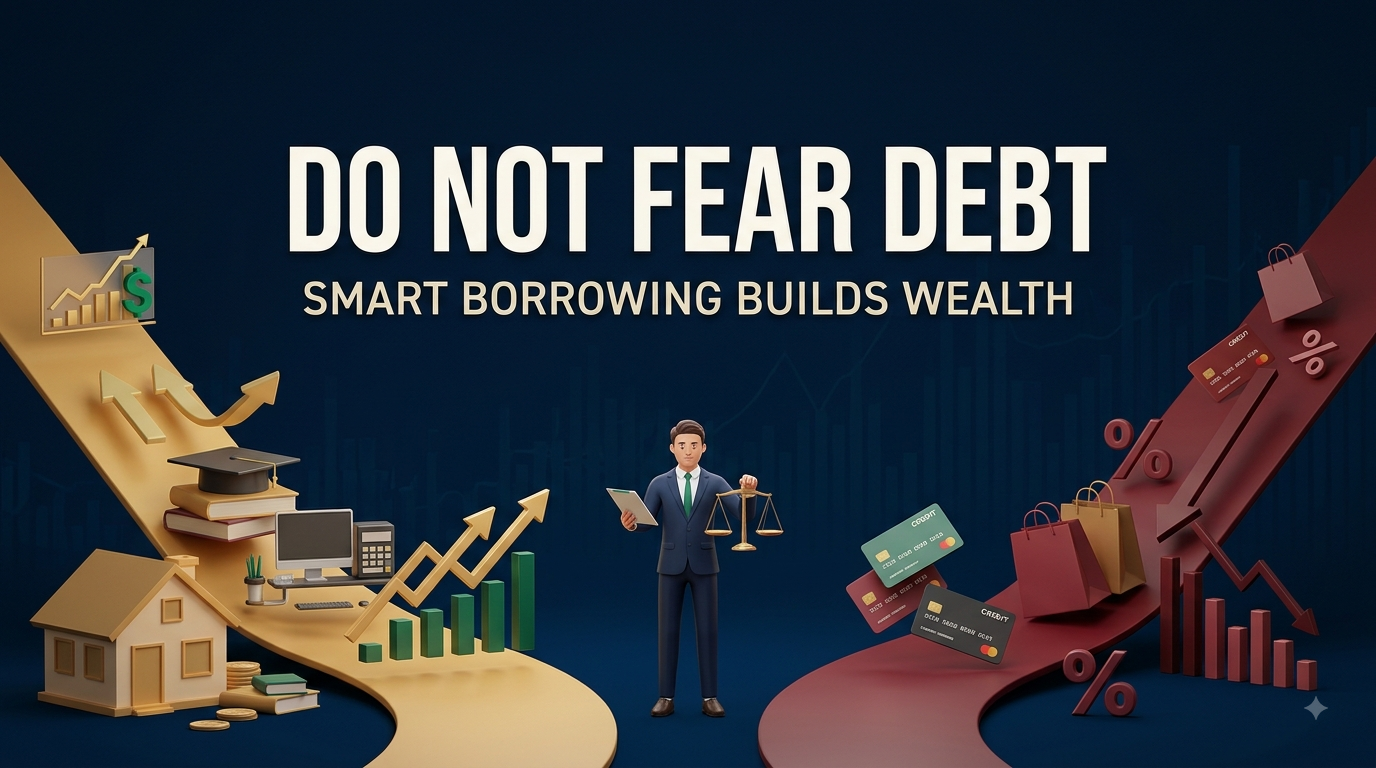
I get asked about this a lot, especially by people who grew up hearing that debt is always a trap. Credit cards, student loans, mortgages: the word itself makes many investors tense up. So let me be clear up front: do not fear debt as a category. Fear the wrong debt, at the wrong price, with no cash flow behind it. That distinction is the whole game.
Most of us are trained to treat borrowing as a moral failure. Markets treat it as a tool. Companies issue bonds to build factories. Countries issue treasuries to fund infrastructure. Households use mortgages to buy shelter decades earlier than cash alone would allow. If you refuse every form of leverage on principle, you are not “safe.” You are often just slower.
This post is my working framework: when debt is productive, when inflation quietly helps the borrower, when leverage belongs in a portfolio, and where the hard red lines sit. No cheerleading for maxed-out credit cards. No fantasy that rates never rise again. Just a clear map.
A quick mental model (illustrative, not advice)
Debt that funds assets, income, or skills with a measurable payoff
Fixed-rate debt below expected long-run portfolio return, paid on schedule
Variable rates, thin buffers, and debt that only works in a boom
High-interest lifestyle debt with no asset and no repayment plan
Why so many people fear debt for the wrong reasons
Fear of debt usually comes from three places. First, personal history: a parent crushed by interest, a friend buried in revolving credit. Second, media stories that treat every household loan like a crisis. Third, a clean-balance-sheet preference that feels virtuous even when it is expensive.
Virtue is not a return. Paying off a 3% fixed mortgage early while sitting out equity compounding can feel responsible and still leave you poorer in real terms. The reverse is also true: carrying 22% credit card balances while “investing” is not bold. It is arithmetic malpractice.
I look at debt the same way I look at a trading strategy. What is the expected payoff? What is the cost of capital? What is the max drawdown of my cash flow if income drops? If those answers are ugly, I walk away. If they are clear and conservative, I do not apologize for using the tool.
Good debt vs bad debt: the only split that matters
If you want one rule that covers most household cases, use this: debt is good when it buys something that can pay for itself or raise your earning power; debt is bad when it funds consumption that is gone the moment you swipe.
Productive (usually good)
Primary mortgage on a home you can afford. Education that raises lifetime earnings. Business loans tied to revenue. Sometimes a car loan if it preserves income and the terms are sane.
Gray zone
Investment property with thin rental coverage. Margin debt in a brokerage account. Variable-rate loans in a rising-rate cycle. Student degrees with weak wage outcomes.
Lifestyle (usually bad)
Revolving credit for vacations, gadgets, and status spending. Buy-now-pay-later stacked across stores. Any loan where the “asset” loses value faster than you pay it down.
Inflation, real rates, and why fixed debt can shrink over time
Here is the part many debt-phobic investors miss. If you hold a fixed-rate loan and wages or asset prices rise with inflation, the real burden of that debt can fall. You repay with “cheaper” future currency, in purchasing-power terms.
That does not make debt free. It does mean a 30-year mortgage at a locked rate is not the same animal as a floating-rate personal loan. In a mild inflation regime, long fixed debt can be less scary than it looks on the statement, especially if the financed asset also appreciates or produces rent/utility value.
Macro context still matters. When leading economic indicators weaken and rates stay high, refinancing options shrink and credit standards tighten. I track that cycle for markets in my leading economic indicators work. Household debt decisions live in the same rate environment, even if your spreadsheet feels personal.
Mortgages, education, and business capital: the classic productive trio
Home mortgages
A mortgage is leverage on shelter. Used carefully, it lets you lock housing costs and build equity while inflation and payments do some of the work. Used poorly, it becomes a bet on endless price appreciation and a lifestyle stretch you cannot service after a job loss.
My filter is boring on purpose: payment including taxes and insurance stays inside a comfort band of take-home pay, you keep a cash buffer, and you are not buying the house to flex. If those hold, I do not lose sleep over a responsible mortgage balance.
Education debt
Student loans are productive only if the degree (or certification) raises expected lifetime earnings enough to clear the interest and opportunity cost. A high-ROI technical path can justify debt. An expensive credential with weak labor demand often cannot. Run the numbers like an investment memo, not like a dream.
Business and self-employment financing
Debt that funds inventory, equipment, or working capital can accelerate a business that already has demand. Debt that funds hope and marketing with no unit economics is just a countdown clock. I only get comfortable when repayment is tied to cash conversion, not to optimism.
How investors should think about leverage
On RavenQuant I spend most of my time on systematic equity strategies, not household balance sheets. Still, the same leverage logic shows up in portfolios. Companies with moderate, productive debt can amplify equity returns. Margin debt in a retail brokerage account can wipe you out in a drawdown because the lender can force liquidation at the worst moment.
That is why I treat brokerage leverage and concentrated sector bets with the same suspicion I apply to fashion ETFs. A calm, rules-based core (for example a quality growth approach like the one I covered in my GARP ETF research) usually beats heroic borrowing against a hot theme.
| Leverage type | Typical use | Main risk | My default stance |
|---|---|---|---|
| Fixed mortgage (affordable) | Primary home | Job loss, rate reset if not fixed | Tool, if cash-flow safe |
| Business loan with coverage | Equipment / working capital | Revenue miss | Tool, with hard covenants |
| Student loan (high ROI path) | Skills / credentials | Weak wage outcome | Case by case |
| Credit cards / BNPL | Consumption | Compound interest | Avoid carrying balances |
| Brokerage margin | Amplified trading | Margin calls, forced sales | Usually avoid |
Do not fear debt: the cash-flow rules that keep you solvent
Fear fades when you replace vibes with rules. These are the ones I recommend people write down before they borrow:
Hard rules
1. Debt service cap. Keep total monthly debt payments (housing + consumer + student) inside a range you can still fund after a meaningful income cut. Many households use ~30% to 36% of gross for housing alone as a planning ceiling; consumer debt on top of that is where trouble starts.
2. Emergency buffer first. Borrowing without cash reserves means the first shock becomes a crisis. Build the buffer before you optimize interest rate minutiae.
3. Prefer fixed when the loan is long. Multi-year obligations and floating rates are a stress cocktail. Fix what you cannot refinance overnight.
Soft rules
4. Match duration. Do not finance a weekend vacation over five years. Match loan life to asset life.
5. Compare to after-tax return. If your expected long-term portfolio return (net of fees and tax drag) clearly exceeds a locked loan rate, aggressive early repayment is not automatically smart.
6. No leverage for ego. If the purchase is mainly about status, it fails the productive-debt test even if the APR looks “fine.”
Pay down debt or invest? The decision most people oversimplify
This is where fear and math collide. People ask: “Should I throw every euro at the mortgage, or invest?” The honest answer is: it depends on the rate, the tax treatment, your job security, and your behavior under drawdowns.
If your loan costs 18%, invest after you kill that balance. Full stop. If your loan is a low fixed rate and you have a proven ability to keep investing through volatility, early repayment can be a psychological win that is still an economic loss. If you panic-sell every bear market, the “guaranteed return” of debt paydown may be the better personal strategy even when the spreadsheet says otherwise.
Behavioral risk is real. I have written about how investors freeze capital with hold-until-break-even thinking. The same psychology shows up in debt decisions: some people need the emotional calm of a smaller balance more than they need a theoretical edge. That is fine, as long as you name it honestly.
When you absolutely should fear debt
I am not here to romanticize leverage. There are clear cases where fear is the correct response:
- You need new debt to service old debt (the classic spiral).
- Interest is variable and your budget only works at today’s rate.
- A single job loss would force asset sales inside a month.
- The loan funds consumption with no residual asset.
- You are leveraging a concentrated bet you do not understand (hot sectors, illiquid deals, friends’ “can’t miss” projects).
In markets, that last point maps to the same warning I give about fashion-driven concentration. Income-oriented equity sleeves like diversified S&P 500 dividend strategies are not magic, but they are usually calmer than borrowing to chase the latest narrative. Systematic approaches I publish on RavenQuant, including long-horizon momentum research, are built to remove ego from the process. Debt decisions deserve the same discipline.
A calm balance sheet is a competitive advantage
Here is the investor angle that ties this together. Opportunity shows up in crashes, rate spikes, and ugly headlines. If your household is one missed paycheck from distress, you cannot buy the dip. You become a forced seller. If your debt is structured and your buffers are real, fear in the market becomes inventory for you, not a personal emergency.
That is the deeper reason I say do not fear debt when it is productive and capped. The goal is not maximum leverage. The goal is optionality: the ability to stay invested, keep contributing, and avoid panic decisions when everyone else is underwater on bad loans.
Conclusion
Debt is not a personality trait. It is a contract with a price, a schedule, and a purpose. Treat it that way and the fog lifts.
Productive loans that fund shelter, skills, or cash-generating assets can accelerate wealth when payments are stress-tested and rates are understood. Lifestyle debt and fragile leverage deserve the fear people dump on every balance. The skill is discrimination, not abstinence.
Write your rules. Run the ugly scenario. Prefer fixed terms for long obligations. Kill high-interest balances first. Then stop apologizing for a mortgage or a business facility that passes the filter. You do not need to love debt. You only need to stop treating every loan as a moral emergency.
FAQ: do not fear debt
What does it mean to do not fear debt?
It means you judge loans by purpose, cost, and cash-flow resilience instead of treating every balance as a failure. Productive, affordable debt can be a wealth tool. Unproductive, expensive debt should still scare you.
What is the difference between good debt and bad debt?
Good debt funds an asset, skill, or cash flow that can justify the interest. Bad debt funds consumption that disappears while the balance keeps charging interest. Mortgages and business capital can be good. Revolving lifestyle credit is usually bad.
Does inflation make fixed-rate debt easier to repay?
Often yes in real terms. Fixed payments stay nominal while wages and prices can rise, so the real burden may decline. Variable-rate debt can erase that advantage when rates jump.
When is investment leverage a bad idea?
When a drawdown can trigger forced selling (margin calls), when you do not understand the downside, or when the borrowed money funds a concentrated fashion bet. Leverage that only works in a bull market is usually a trap.
How much of my income should go to debt payments?
There is no universal number, but healthy plans leave room for a 15% to 25% income shock without missing payments. If a temporary cut would break the budget immediately, the debt load is too high regardless of the interest rate.
Should I pay off a low-rate mortgage early or invest instead?
Compare the after-tax mortgage rate with your expected long-term investment return and your behavior in bear markets. High-interest debt should be cleared first. Low fixed debt is a math-and-psychology decision, not a moral one.