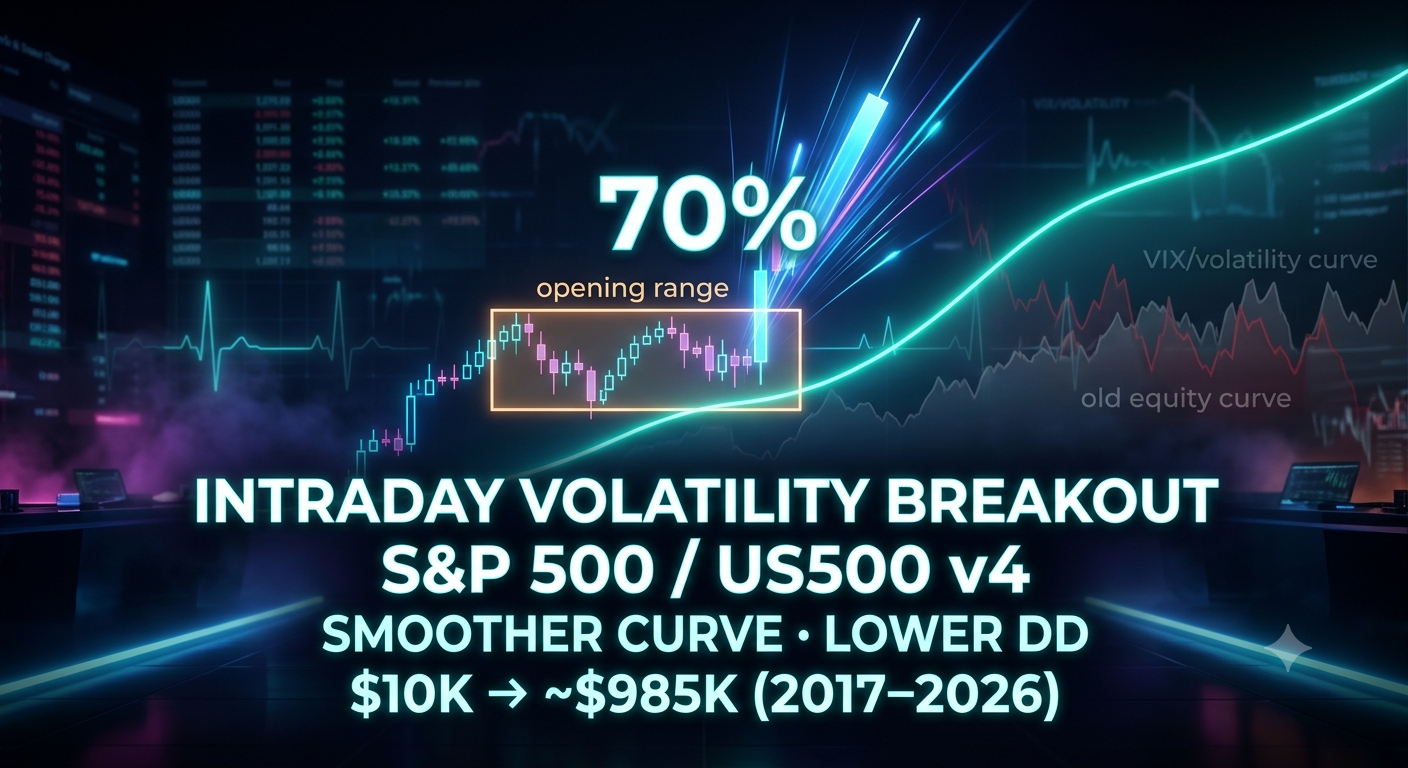
Intraday Volatility Breakout Strategy v4: Smoother Curve, Lower DD on US500
I get asked a lot whether Daybreak can get “safer” without killing the edge. That is exactly what I chased in this update. The core is still an intraday volatility breakout strategy on US500: build the morning range, trade the breakout, manage with breakeven + trail, and finish flat — the same engine I walked through in the original piece, Exploiting the Open: An Intraday Volatility Breakout Strategy on the S&P 500. Version 4 adds a VIX filter, a short-timeframe trend gate, and tighter parameters so the equity path stops looking like a rollercoaster for the same style of compounding.
I compared the prior Medium engine to Daybreak US500 v4 on the same window (M15, 2017.06.01–2026.06.30, $10k start). Net profit stayed in the same ballpark. Drawdown and path smoothness did not.
Medium Net*
~$985k
v4 · $10k start
Equity Max DD*
~29%
was ~53% on prior Medium
Profit Factor*
1.46
was 1.25
CAGR*
~66%
Medium · ~9 years
These backtests include broker spreads and fees in the simulation. Because the system is designed to finish flat, overnight financing / swap costs do not apply here. Tester slippage delay was set to 500 ms; for this style of system that is not a make-or-break assumption — Daybreak is not a high-precision scalper, and a little slippage can even improve results occasionally. Live, a commission-free account is recommended (ideally with a tight spread as well).
What is an intraday volatility breakout strategy?
An intraday volatility breakout strategy waits for the market to define an early range, then buys strength or sells weakness when price leaves that box. Daybreak does that on the US open window (ET), sizes risk from the range stop, and aims to be flat by the session close. No overnight inventory by design (aside from the short, optional EOD reverse window). For the full opening-range background and the first Daybreak backtest write-up, read the original strategy article.

What changed in RavenQuant Daybreak v4?
More robust EOD
Cleaner session flatten and a more conservative production reversal setup, so end-of-day behavior is less noisy.
VIX filter
Uses market fear readings (VIX) as an extra session gate — so the system can stay more selective when volatility conditions look hostile.
Trend filter
A short-timeframe trend gate that can drop the weaker side of the morning breakout setup.
On top of that I retuned production parameters (Hard TP, pyramid distance, risk ceiling). Fewer trades, better average quality. That is where most of the DD cut comes from.
Medium vs prior Medium: the curve comparison
Here is the same Medium backtest window overlaid — prior engine in grey, v4 in blue. Ending balances are close; the path in between is the point.
| Metric | Prior Medium | v4 Medium |
|---|---|---|
| Total net profit | $950,217 | $984,561 |
| Profit factor | 1.25 | 1.46 |
| Recovery factor | 5.92 | 9.88 |
| Daily Sharpe* (custom) | — | ~1.40 |
| Daily Sortino* (custom) | — | ~3.68 |
| Equity max DD | 53.1% | 29.4% |
| Balance max DD | 51.3% | 35.7% |
| Total trades | 2,568 | 1,837 |
| Ulcer index (path) | ~0.15 | ~0.085 |
Same deposit, same dates, same symbol family. The v4 path spends less time underwater and prints new highs more often. That is the “smoother curve” part in plain English.
All risk profiles: profit, DD, and custom metrics
Full risk ladder from the same Medium production set window (US500 M15, Jun 2017 – Jun 2026, $10,000 start). Profit, equity DD, and recovery come from the Strategy Tester export; Daily Sharpe / Sortino are the OnTester custom scores from the daily equity path (rf = 0, √252) in sortino-recovery-sharpe.xml. MetaTrader’s built-in Sharpe is misleading here — ignore it.
| Risk profile | Net profit | Profit factor | Equity DD % | Recovery | Daily Sharpe* | Daily Sortino* | Trades |
|---|---|---|---|---|---|---|---|
| Very low | $404,729 | 1.46 | 26.2% | 10.12 | 1.39 | 3.60 | 1,732 |
| Low | $642,321 | 1.46 | 27.5% | 10.04 | 1.40 | 3.70 | 1,836 |
| Medium (shipped) | $984,561 | 1.46 | 29.4% | 9.88 | 1.40 | 3.68 | 1,837 |
| High | $1,530,334 | 1.45 | 32.2% | 9.74 | 1.36 | 3.52 | 3,519 |
| Very high | $2,415,105 | 1.46 | 34.2% | 9.81 | 1.36 | 3.51 | 5,028 |
| Extreme | $3,545,204 | 1.46 | 37.2% | 10.05 | 1.35 | 3.42 | 6,339 |
Higher profiles compound harder and accept deeper equity DD. Custom Sharpe / Sortino stay in a tight band across the ladder — the main trade-off is growth vs drawdown depth, not a collapse in risk-adjusted quality. Treat these as research scores for comparison, not a promise that live trading will print the same numbers.
Extreme mode: still aggressive, still saner than the old ceiling
Extreme on v4 made about $3.55M with equity DD around 37% in this risk-profile sweep. That is not “safe” in the casual sense — the swings are real — but it is far tighter than older very-high style runs that sat near 70% DD. If Medium is your default, keep Extreme as an intentional choice, not a panic upgrade mid-drawdown.
Conclusion
Daybreak v4 is the same intraday volatility breakout strategy idea with better gates. Medium keeps the compound story and cuts a large chunk of drawdown. Extreme remains available without returning to the old “hero DD” profile. Follow the manual for live setup, and judge it on months, not days.